Ultra-high speed data
In a unique dyno test series MXScandinavia on Thumper Talk dyno tested two shim stack configurations and also obtained direct shim stack deflection measurements using a finger press.
A finger press inserts metal rods through the valve ports to directly measure the force required to produce a specific deflection. The MXScandinavia data shows the stiffness of the shim stack is nonlinear and the nonlinear behavior increases with stack lift. Nonlinear stiffness is one reason why the shim factor linear stiffness theory performs poorly in scaling shim stacks.
Shim ReStackor analysis of the tested shim configurations closely follows the nonlinear finger press stiffness data and the damping force data up to the dyno velocity limit of 120 in/sec. At 120 in/sec the shim stack edge lift was 0.02 inches, approximately one third of the finger press test range.
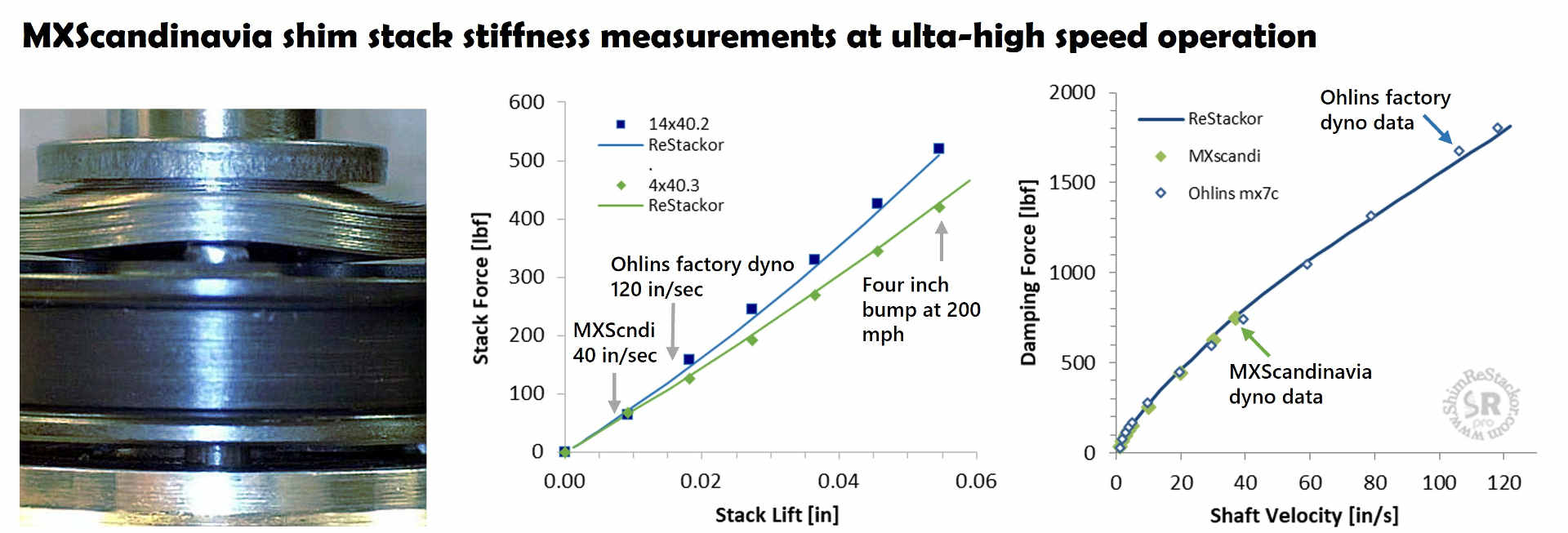
The finger press measured stack deflections well beyond the dyno test limit up to deflections of 0.06 inches equivalent to hitting a four inch bump at 200 mph.
The finger press data verifies Shim ReStackor shim stack stiffness calculations, verifies the nonlinear stiffness behavior of shim stacks at high deflections and gives confidence applying Shim ReStackor calculations at extreme conditions well beyond the limits of conventional dyno testing.
rmz250 split shim crossover
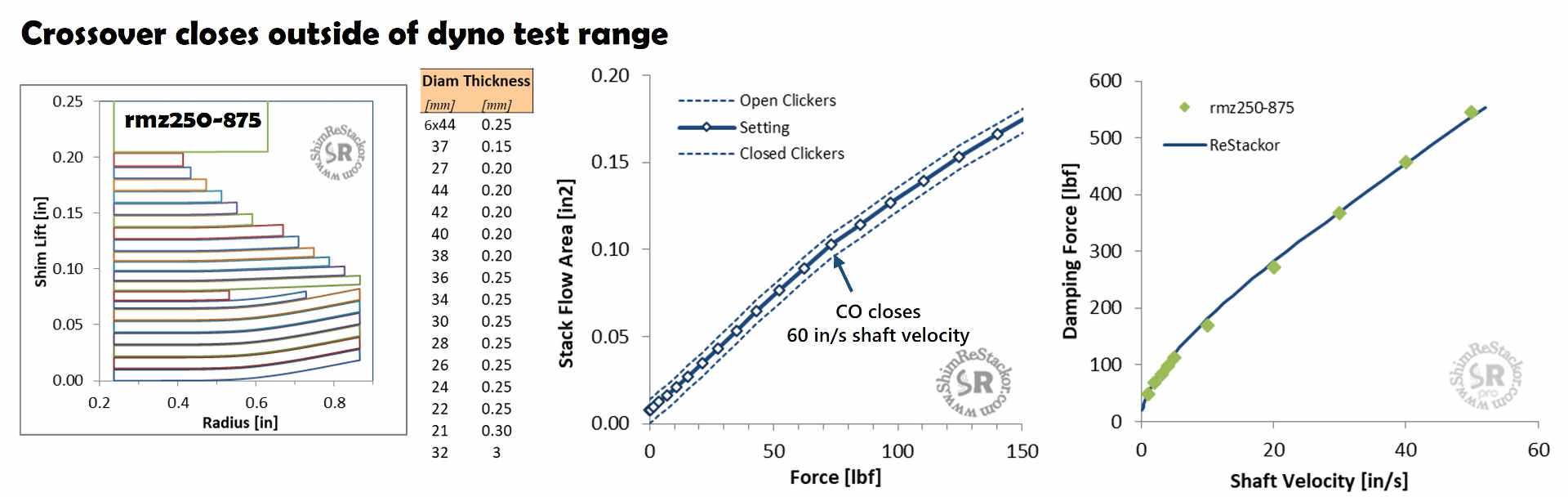
Split crossovers (linky sample apps) use two shims to form the crossover gap. Split shims smooth the bend radius at the crossover shoulder to prevent kinking of the face shims on the sharp shoulder of a single crossover shim.
Valving Logic dyno testing of an rmz250 used a split shim crossover. Deflection of the high speed stack by the interactive crossover delayed closure of the crossover to 64 in/sec. However, the dyno was not capable of testing beyond 50 in/sec. The data provides no information on the expected damping force increase after the crossover gap closes.
High speed closure of crossover gaps and valve port flow restrictions can significantly increase high speed damping making extrapolation of dyno data beyond the test range risky.
rmz450 trapped crossover
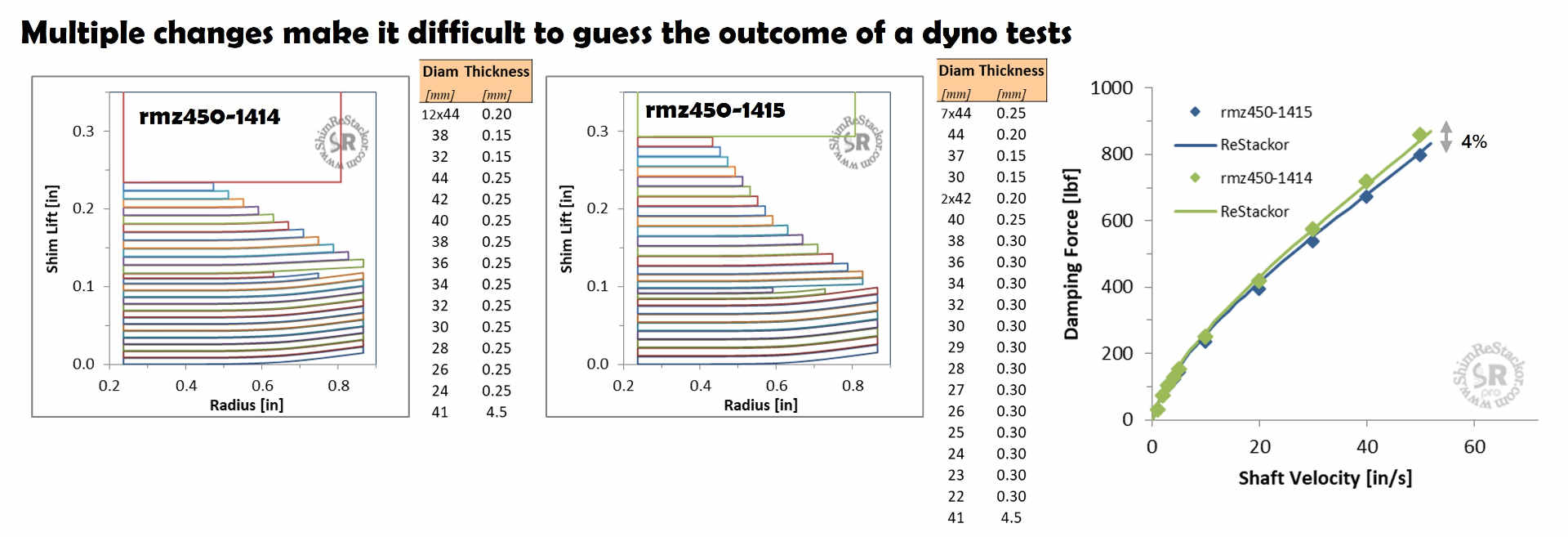
Valving Logic on Thumper Talk tested trapped crossover shim stack configurations. Differences in the number of face shims, crossover configuration and high speed stack stiffness makes it difficult to guess the expected damping force differences between the two shim stack configurations.
Computing the damping force of complex shim stack configurations with multiple differences in the crossover configuration, high speed stack and clamp is the central purpose of Shim ReStackor. The computed results (lines) closely follow the dyno test data (symbols).
rmz450 faux crossover
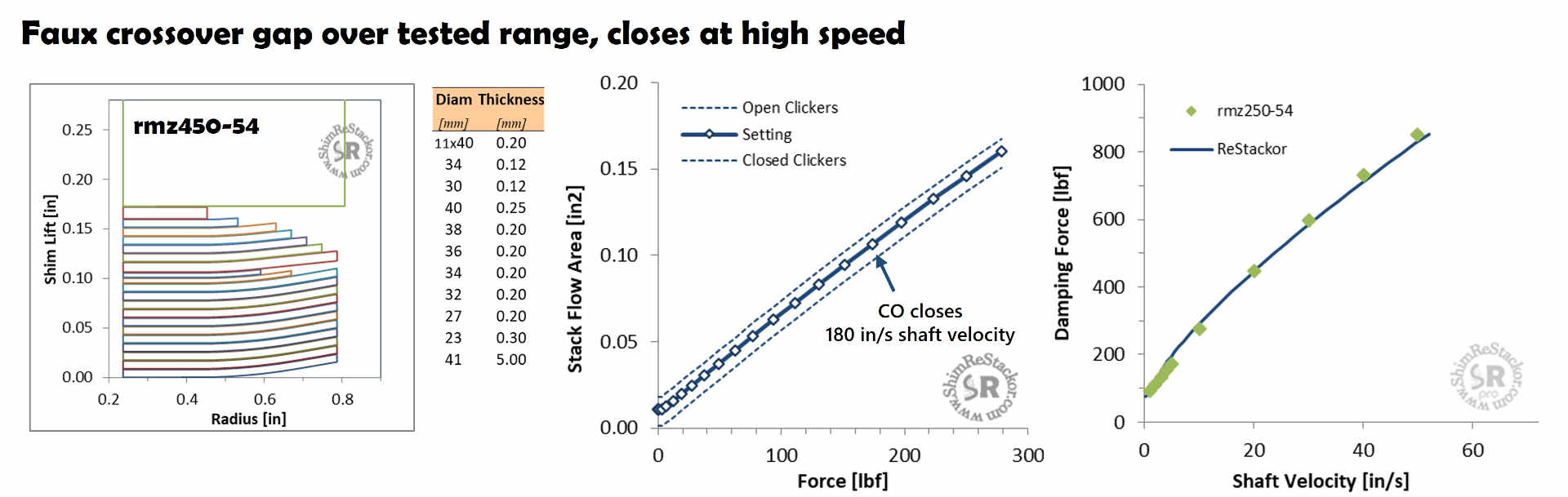
A faux crossover gap never closes. Faux gaps are created by large crossover shim diameters, stiff low speed stacks or soft high speed stacks that do not produce enough force to close the crossover gap.
Valving Logic dyno tests of an rmz450 shock on Thumper Talk demonstrate the operation of a faux crossover.
Shim ReStackor analysis of the configuration shows the crossover gap eventually closes at a shaft velocity of 180 in/sec. However, the soft high speed stack used in the configuration produces virtually no change in damping force at the crossover closure. In that sense, the configuration demonstrates “faux” over the range tested.