High speed damping rmz250
A general shim stack tuning misconception is high speed damping is controlled by the high speed stack. That creates the perception removing a couple of shims from the high speed stack will “loosen-up” high speed damping while having little effect on low speed.
Dyno testing and Shim ReStackor calculations show that approach does not work.
Valving Logic provides a dyno test example on Thumper Talk. The rmz250-248 shim stack runs a full stack taper. The rmz250-152 configuration completely removes the high speed stack creating the expectation of “loosening-up” high speed damping.
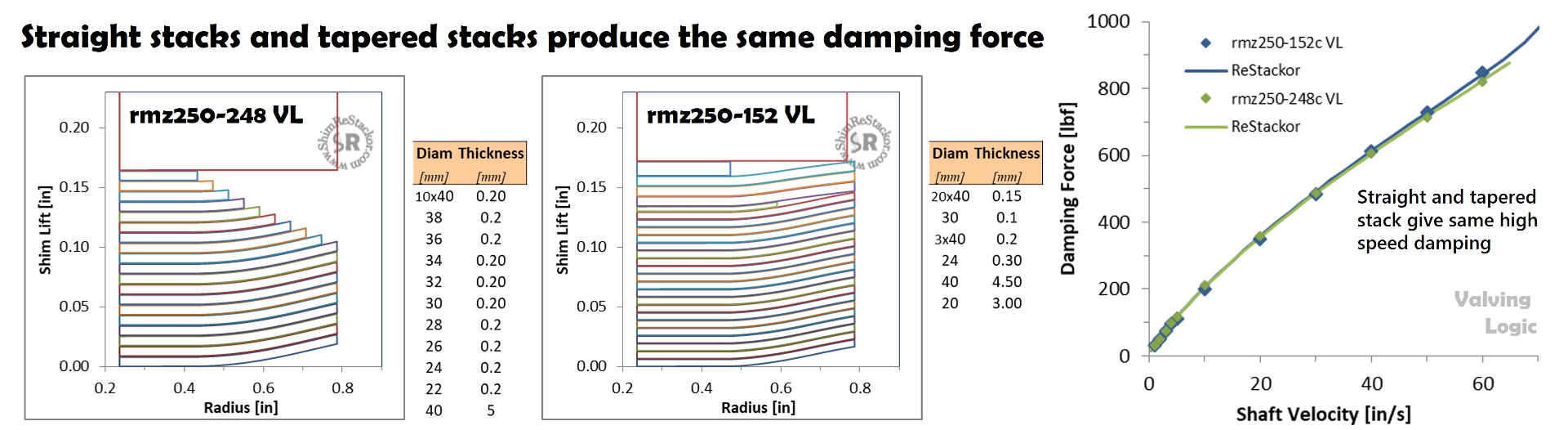
Dyno tests of the two configurations shows no difference in high speed damping (data points). Shim ReStackor calculations (shown as lines) show the same thing.
To get softer high speed damping while keeping low speed the same requires using a preload ring-shim in the shim stack (linky, fundamentals).
Interactive crossover dyno testing
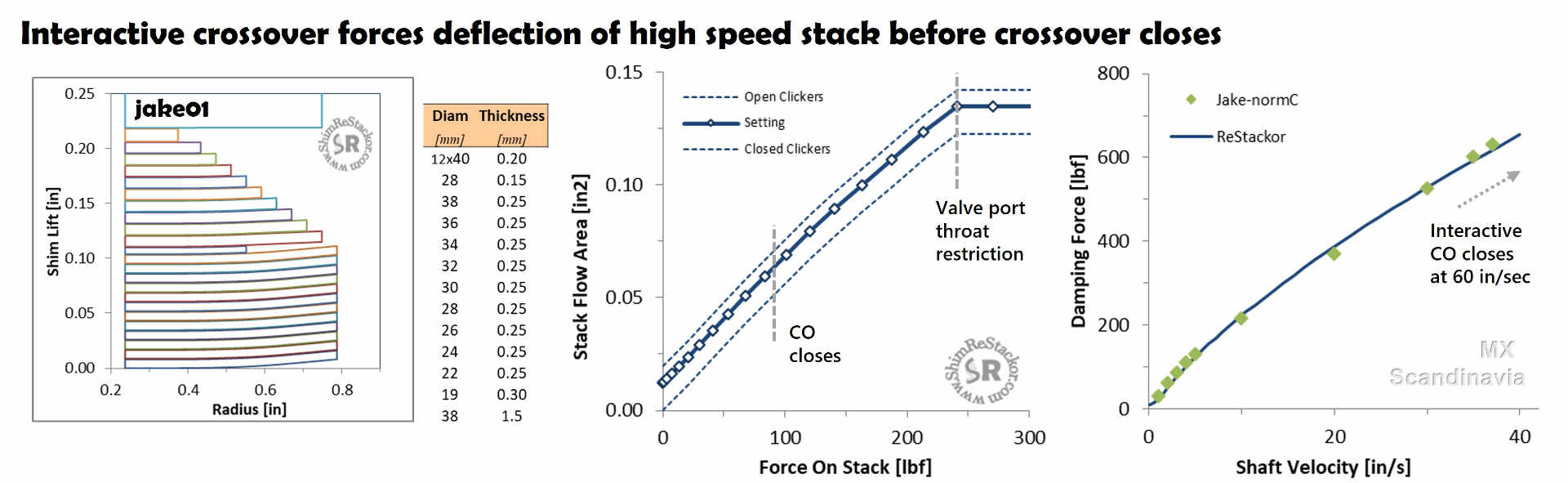
Interactive crossovers (sample apps) use a shim diameter that is larger than the stack clamp. The larger crossover diameter transfers force from the face shims directly into the high speed stack forcing the high speed stack to deflect before the crossover closes. Interaction with the high speed stack softens the crossover closure event.
Shim ReStackor analysis of an interactive crossover tested by MXScandinavia on Thumper Talk produces a crossover closure velocity of 60 in/sec. However, the MXScandinavia dyno could only test to shaft speeds of 40 in/sec.
The test illustrates a typical dyno frustration. At the velocity limit of the test no unusual behavior is observed. However, the crossover gap has not closed creating uncertainties the shock absorbers high speed performance.
Shim ReStackor helps relive those uncertainties with the capability to compute high speed shock absorber performance and evaluate crossover closure velocities and the effect of valve port flow restrictions that kick in beyond the limits of conventional dyno testing.
Stack taper shim factors
MXScandinavia dyno tested shim factor equivalent stacks on Thumper Talk to evaluate the accuracy of shim factors for scaling shock absorber damping force. The test replaced all of the 0.20 mm shims in the shim stack taper with a pair of 0.15 mm shims. By shim factor theory a pair of 0.15 mm thick shims should be 16% softer than a single 0.20 mm shim.
Dyno tests of the shim stack configurations shows the theoretically softer stack actually produces 5% more damping force as shown by the MXScandinavia dyno data points. Shim ReStackor calculations are shown by the lines and verify the dyno test data and the 5% damping force increase for the theoretically softer shim stack.
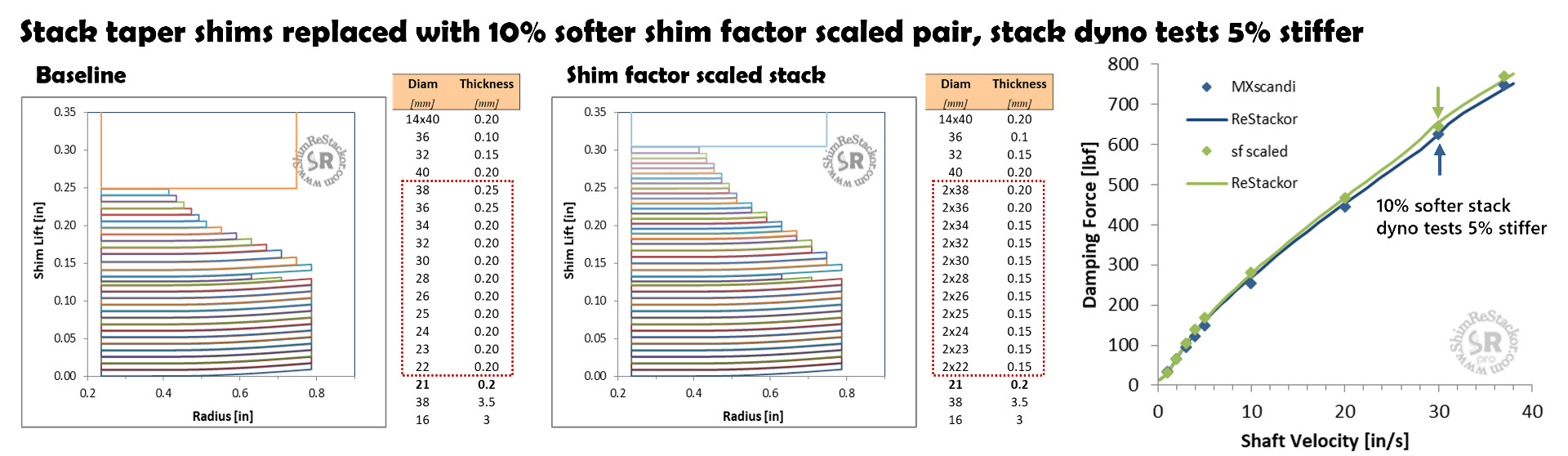
The difference in damping force is caused by shim friction. Replacing the stack taper shims with a softer pair of 0.15 mm shims doubles the shim interface area and the resulting friction. The friction increase results in the theoretically softer shim stack producing more stiffness and damping force than the baseline configuration.
rmz450 trapped crossover
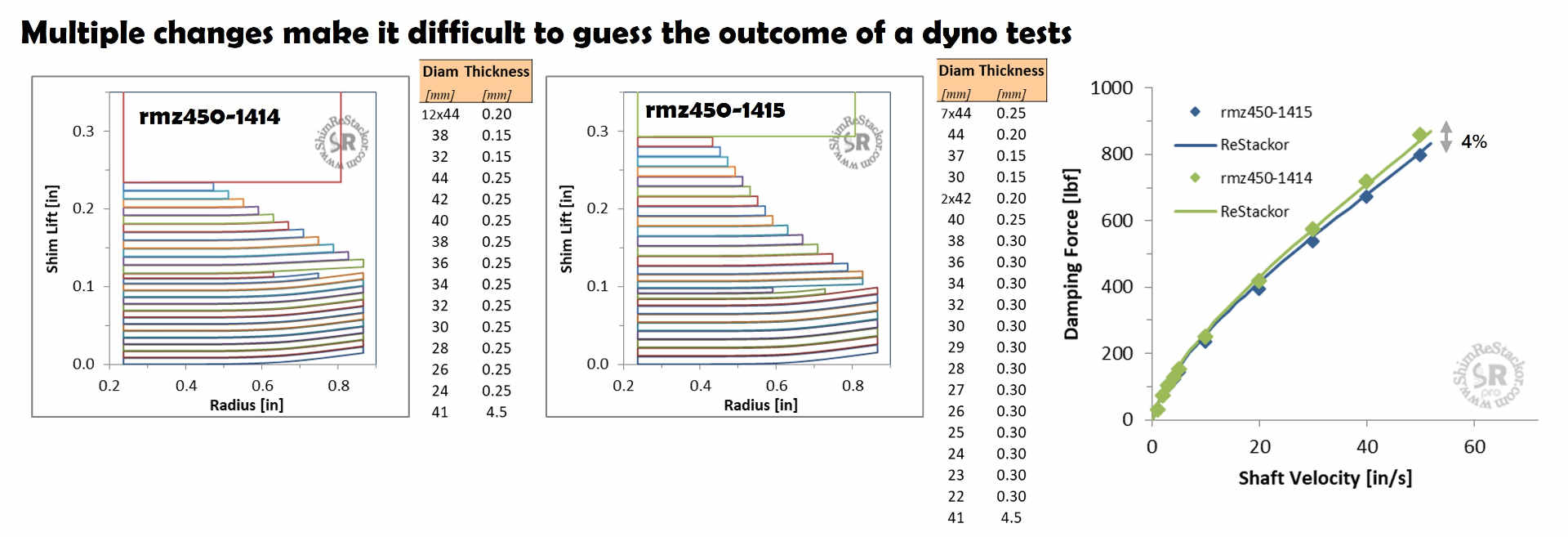
Valving Logic on Thumper Talk tested trapped crossover shim stack configurations. Differences in the number of face shims, crossover configuration and high speed stack stiffness makes it difficult to guess the expected damping force differences between the two shim stack configurations.
Computing the damping force of complex shim stack configurations with multiple differences in the crossover configuration, high speed stack and clamp is the central purpose of Shim ReStackor. The computed results (lines) closely follow the dyno test data (symbols).